
What the future of educational neuroscience looks like: a report from Chile
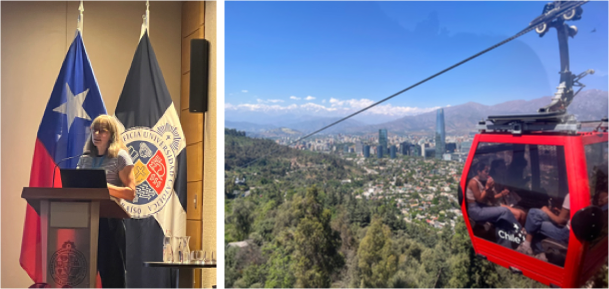
How do we move from understanding the brain to improving outcomes in the classroom? This was the central question as researchers from the Centre for Educational Neuroscience (CEN) travelled to Santiago, Chile, in November 2025 to share expertise at two major Latin American Science of Learning events.
The two events brought together researchers from the Millennium Nucleus for the Science of Learning (MiNSoL), UNESCO Regional Office in Santiago, the Centre for Advanced Research in Education (CIAE) at the University of Chile, and the CEN in the United Kingdom, as well as researchers from Latin America and the Caribbean, and Europe, with the goal of strengthening links between science and education.
On Day One, Professor Michael Thomas, Professor Andy Tolmie, Dr. Rebecca Gordon, and Dr. Emma Meaburn joined international experts at the inaugural Conference on the Science of Learning in Latin America (CCA 2025) to discuss the state of the science of learning in 2025, and how to translate educational neuroscience insights into education policy and teaching practice. On Day Two, the conversation continued with the UNESCO Regional Gathering on the Science of Learning, hosted in collaboration with UNESCO Santiago.
Day One: Inaugural Conference on the Science of Learning in Latin America
The conference opened with a keynote address from Professor Michael Thomas, where he mapped out the current state of the field. He moved beyond skills and knowledge acquisition to emphasise the importance of wider factors that underpin learning. Factors such as sleep, diet, mental health, and the physical environment can all help (or hinder) the brains ability to learn.
This set the stage for Dr. Rebecca Gordon, who expanded on the environmental aspect by discussing her planned country comparison study between Brazil and the UK. The project proposes to examine the environmental factors that might affect the development of the cognitive mechanisms implicated in the learning process, and how these might be mediated by interventions, policy and practice.
New evidence
One of the most practical takeaways came from Professor Andy Tolmie, who presented findings from a recent randomised cluster trial on spaced learning, the technique of breaking learning into short intervals spaced out over time with distractions in between. The study, implemented in 18 UK secondary school physics classrooms, found that combining one hour of spaced learning with conventional teaching resulted in 60% to 90% greater learning than either on their own (partial eta-square = .06 to .29).
Dr Emma Meaburn provided an example of taking a genetically informed approach, presenting findings from a study that explored the pathways linking parental genetic liability for mental health conditions to variation in adolescent internalising and externalizing behaviors. The study identified that genetically influenced environmental pathways are important in the development of early adolescent internalising behaviours, highlighting the potential of family-centered strategies for mitigating intergenerational risk for behavioural difficulties.
Why the brain matters for education
A core theme of the day was defining what value neuroscience brings to the science of learning. Professor Thomas outlined three key avenues:
Biological constraints: Learning happens within the brain, which means it is subject to specific biological limitations, which have been shaped by evolution. This can account for why we rarely forget motor skills (like riding a bike) or fear responses (like being scared of spiders), yet struggle to recall abstract facts (like the capital of Mongolia). These differences arise because different types of knowledge are stored in different brain regions and systems, with distinct biological properties.
Granularity: Neuroscience allows us to break down complex concepts like “attention” into smaller components, such as inhibition or mental effort. Educators can use this granular knowledge to tailor instruction and learning environments to these more specific underlying processes to help learners.
New interventions: Evidence-based innovation can lead to new tools. For example, the CEN’s UNLOCKE project used knowledge of inhibitory control to develop software that helps children learn counter-intuitive scientific concepts. Similarly, research led by Usha Goswami has shown that training rhythmic skills in the early years can help mitigate dyslexia-related word processing difficulties.
Emerging trends and knowledge gaps
While there is plentiful data on literacy and numeracy in the early years, the conference highlighted the need to expand our scope. Professor Thomas highlighted emerging research in the areas of:
General skills, like executive function, working memory and social-emotional skills
The home environment, and its impact on school readiness
How technology and AI is reshaping the classroom, and its impacts in learning
However, gaps remain. There is still much to understand regarding adult learners, secondary school education, the arts and humanities. Furthermore, there is a need to develop the science of teaching, that is to understand how the teacher-student relationship and teacher characteristics directly affect student engagement and learning.
The challenge: from establishing consensus to influencing policy
The ultimate challenge for educational neuroscience is determining what works, for whom, and in what context, and in the hands of what educators.
Professor Thomas warned against focusing too heavily on the child while ignoring the wider nested systems of schools, society, and the government that can support (or hinder) learning. He proposed that to tackle this, universities could act as “R&D hubs” to build the evidence base, co-creating research with schools to ensure the evidence generated is relevant and timely. Gatekeeper organizations (like the Educational Endowment Foundation in the UK) can then curate this evidence, which can feed into government policy and educational targets.
To support this vision for the future, the CEN has recently established working groups to build academic consensus on where the evidence is strong, where it is weak, and what does not work. You can read about the new CEN working groups here.
Day Two: Science of learning meets policy
The conversation continued on day two with the UNESCO Regional Gathering on the Science of Learning, hosted in collaboration with UNESCO Santiago.
Professor Thomas returned to deliver a second keynote, ‘Science of Learning and Policy: Gaps, Overlaps, and Opportunities.’ Using the UK education system as a case study, he took a deep dive into the relationship between what researchers find, what governments write in policy documents, and what happens in schools.
The ‘opportunity mission”
Analysing recent UK Department for Education (DfE) policy documents, Professor Thomas noted a strong interest in the Early Years, childcare, and school readiness. The goal here is clear: to break down barriers to opportunity and address disadvantage by targeting resources, and in a scalable and cost-effective way. There is also consideration of broader social and economic contexts, such as how to best equip children with the skills needed for their journey into adulthood and the labour market.
Where the science of learning fits in
Science of Learning and educational neuroscience is well-placed to solve many of these challenges. It can offer evidence in core areas like early development and student attainment. It can also help address modern concerns such as the impact of AI, social media, and mobile phones, as well as the sources and impacts of rising anxiety.
The blind spots: where we need to grow
However, Professor Thomas was candid about where the field currently struggles to provide insights. Because neuroscience focuses on how individuals learn, it often lacks the tools and approaches to address large-scale issues. He identified four key “gaps” where the science needs to expand to meet policy needs:
Systemic issues: Educational neuroscience investigates neural and cognitive processes, meaning it often has little to say about macro-level issues like school leadership and governance.
Workforce challenges: We currently lack research on the economics of education, such as how to recruit and retain teachers and early years providers, or how to support and incentivize lifelong learning.
Socio-cultural context: Lab-based research can be narrow (e.g., focusing on attention mechanisms) and fail to account for the messy real-world contexts that matter in education, such as housing insecurity and crime.
Building infrastructure: Factors such as the design of new schools and inclusive classrooms to climate change mitigation strategies are often overlooked, yet they have a massive impact on learning.
The ultimate challenge: translating the science
The keynote concluded by addressing the translation gap. Rather than expecting busy teachers to act as researchers, the research community must take responsibility for translating robust evidence into accessible, actionable strategies, and facilitate its integration into teacher training and continuing professional development. Importantly, the approaches we take must respect teachers’ time, knowledge and needs.