
New Working Groups at the Centre for Educational Neuroscience (CEN)
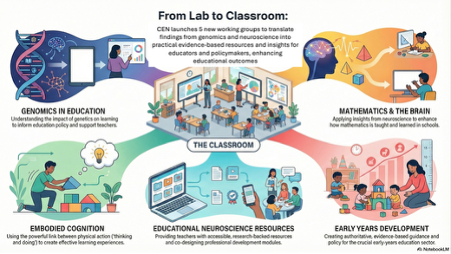
The Centre for Educational Neuroscience (CEN) is pleased to announce the establishment of several new working groups, formalising our commitment to translating rigorous neuroscientific research into actionable insights for policy, practice, and the classroom. These groups will focus on key areas spanning from genomics to physical learning, ensuring that the latest evidence enhances educational outcomes across the sector.
1: CEN-GEN Working Group
The CEN-GENomics working group (CEN-GEN) was established in Spring 2025 to address the rapidly evolving intersection of genomics, social science, and education. This is a critical area, especially since genomics featured in the Department for Education’s (DfE) 2025 Areas of Research Interest document, highlighting the need to understand its implications for policy, practice, and families.
Who is included?
Membership includes Emma Meaburn, Michael Thomas, Jo Van Herwegen, and Mojtaba Soltanlou, alongside external experts Yulia Kovas (Hult International Business School) and Tim Morris (UCL).
Focus in the Near Future?
The group has outlined two initial stages toward its long-term goal of supporting strategic planning by the DfE and other policymakers:
Building Scientific Consensus: The group is consulting with the DfE and gathering perspectives regarding the state of the science and plausible evidence-based pathways to translation. These findings will be published as a report intended to serve as a grounded and accessible resource for policymakers.
Teacher Consultation: Following the report, a workshop for teachers and educational professionals is planned for spring 2026. The goal is to explore teachers’ understanding and concerns regarding genomic information, and identify the professional development and support they might require.
2: CEN Early Years Working Group
The CEN Early Years Working Group was formed through a partnership between CEN and SEY (the Institute for the Science of Early Years). This group brings together leading researchers and senior figures from the UK’s major early-years organisations and promotes genuine two-way communication between research and practice.
Who is included?
This group is led by CEN member Sam Wass with contributions from Gemma Goldenberg, Denis Mareschal, Emily Farran.
Focus in the Near Future?
The primary focus is to co-develop authoritative, evidence-based policy positions and best-practice guidance for the early-years sector. The group leverages members’ extensive networks, sharing the latest neuroscientific insights while ensuring that the experiences and perspectives of practitioners shape future research.
3. CEN – Educational Neuroscience in the Classroom
This working group was established in Spring 2025, building on our research centre’s longstanding commitment to translating research into practice for teachers.
Who is included?
The membership includes Rebecca Gordon (Lead), Emma Meaburn, Gemma Goldenberg, Roisin Perry, Mojtaba Soltanou, Laura Outhwaite, and Jo Van Herwegen.
Focus in the Near Future?
The group aims to strengthen CEN’s role as a trusted source for evidence-based insights into the science of learning:
Resource Consolidation: They will map the extensive evidence body already available through the CEN, creating a searchable database that consolidates existing resources, including website materials and videos. This is intended to ensure teachers can easily access high-quality, research-informed content.
Professional Learning Co-design: The group will engage teachers directly through funded focus groups to identify priority topics and preferred formats for professional learning. This co-design process will then inform the development of a teacher-focused educational neuroscience module.
Integration into Teacher Pathways: Leveraging CEN’s network of over 200 partner schools, the group will support the Initial Teacher Education (ITE) and Early Career Framework (ECF) team at UCL in integrating educational neuroscience into teacher development pathways.
4. CEN Maths Working Group
The CEN–Math group was established in Spring 2025 to highlight the critical role of mathematical learning in school readiness, academic achievement, and learning generally. Mathematics is a cornerstone of formal education: numeracy, alongside literacy, underpins the ability to access and build knowledge across subjects. Our initial objectives are to translate insights from the educational neuroscience of mathematics into practice—bringing evidence-based approaches to schools, teachers, and policymakers—and to promote understanding of how scientific findings can enhance educational outcomes.
Who is included?
This group is led by Mojtaba Soltanlou and includes Jo van Herwegen, Emily Farran, Michael Thomas, Rebecca Gordon, Flavia Santos, Laura Outhwaite, Katie Gilligan-Lee, and Iroise Dumontheil.
Focus in the Near Future?
The initial objectives are focused on translating insights from the educational neuroscience of mathematics into practice. This involves bringing evidence-based approaches to schools, teachers, and policymakers and promoting understanding of how scientific findings can enhance educational outcomes.
5. CEN Embodied Cognition Working Group
The CEN – Embodied Cognition group was established in Spring 2025, recognising the importance of bodily engagement in cognitive processing for learning. This principle is based on the strong interconnection between “thinking and doing”. Bodily engagement includes gesture, movement, exploration, manipulating concrete objects, spatial reasoning, and other sensorimotor experiences, which are identified as powerful tools for effective learning.
Who is included?
The group is led by Emily Farran, and also includes Michael Thomas, Rebecca Gordon, Andy Tolmie, Denis Marschal, Spencer Hayes, and Ori Ossmy.
Focus in the Near Future?
The initial objectives are centred on translating research into accessible policy-ready and practice-ready formats. They also aim to disseminate the current consensus on what is known (and what is not known) about how embodied cognition benefits learning.
An Ongoing Commitment to Bridging Science and Practice
By combining rigorous research with practical application, these new working groups underscore the Centre for Educational Neuroscience’s dedication to empowering educators with the knowledge and tools required to enhance learning outcomes. We look forward to sharing the output from these groups as they translate complex scientific findings—from genetics to sensorimotor experiences—into tangible benefits for classrooms and policymakers. Our commitment is to ensure all practitioners and policy makers have access to information that can inform their decision making.